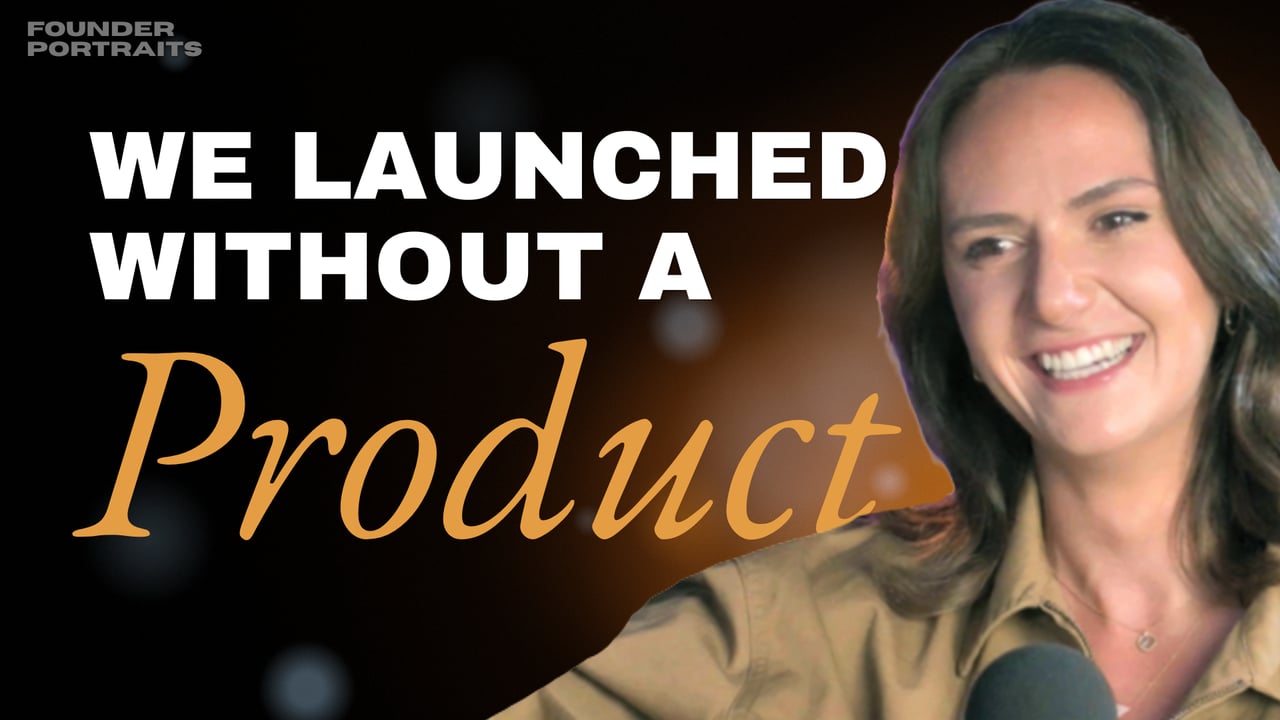
Clarke Pennington
Hedge Fund to Founder: Building Lasso in 11 Months

Summary
Clarke Pennington spent a decade in finance: investment banking, Columbia MBA, a consumer hedge fund. Then he left to build Lasso, a better-for-you gelatin cup with protein and fiber that no one had been able to manufacture before. He gave himself 12 months. He did it in 11, with six failed production runs, a co-manufacturer who wouldn't return his calls for four months, and stress so severe his hair started falling out. We talk about what it's like to leave a career everyone envies, what happens when the people who raised you to always perform your best become your investors, and the line between relentlessness and self-destruction. "As long as you don't kill yourself in the process." @eatlasso on Instagram and TikTok Claim Your Complimentary Career Clarity Session: https://www.wellthbykirsten.com/booking-calendar/complimentary-consultation?referral=book_button_widget
Transcript: Clarke Pennington on Founder Portraits
0:00I was literally going bald
ClarkeI developed stress alopecia. All of my hair was falling out. And I thought, I've gone through so much, nothing is going to hold me back. I was literally going bald from trying to figure out this problem, and I thought, if this is the worst of it, I can get through it. I'll put a headscarf on and go about my day.
0:52Who is Clarke Pennington
ChristianneClarke Pennington had the resume: investment banking, Columbia Business School, a hedge fund. He left all of it behind to build Lasso, a better-for-you gelatin cup packed with protein and fiber, a product so difficult to manufacture that no one had done it before. He gave himself 12 months to figure it out and did it in 11. Today we talk about the drive behind that kind of speed, what it costs, and whether it ever turns off. Here's Clarke.
1:24What he thought success looked like in banking
ChristianneClarke, thank you so much for coming on. You have a finance background, and investment banking is a pretty tried-and-true path. When you started, what did you believe about how the world worked and what success looked like?
ClarkeI grew up in a pretty traditional household. My parents both went to grad school, worked what felt like incessantly, and stayed at the same job their whole careers. So that was my view of the world: you land a job, you stay there, you work hard, and that's the be-all and end-all. I approached investment banking from that lens. I knew I wanted to transition at some point, but I didn't know to what. I came from an untraditional background and a non-target school, so even landing that opportunity was huge for me. I was excited just to get in the door and be surrounded by smart people.
2:31Why he left after six years
ChristianneWhat prompted the move?
ClarkeAfter six years, I realized banking is a training ground, a mental boot camp in some respects. It teaches you to be poised, and it takes who you are and turns you into more or less a machine. I enjoyed the grind, but something was missing. A deal could come in at 10 p.m. on a Friday and lock up my entire weekend, even if I had plans.
3:25The resume: banking, business school, a hedge fund
ClarkeI went to business school. I already had a finance degree, so I didn't want to copy and paste it. I wanted to pick up mental models that might transfer. Then I took a job at a consumer-focused hedge fund, covering consumer packaged goods companies from personal care to big food to travel and leisure, for the last two years.
ChristianneThree marks of a really successful resume. What do you think about that?
ClarkeIt took a lot of hard work. None of it was easy. In fact, I was denied from business school the first time.
ChristianneDo you remember where you were when you found out?
ClarkeSitting in my apartment. I went for a really long run, then went out and ordered the lobster mac. I thought, I'm going to treat myself. I thought I'd set myself up for success. I'd hired a consultant. But I knew the stats: the acceptance rate for white male investment bankers was under 2%.
ChristianneDid any part of you have to die to move on from banking? It's so many hours and so much of your mental space. I used to dream about it.
ClarkeI was just excited for the next chapter. It wasn't until I quit that I realized how much of a chokehold it had on me. I woke up with anxiety for about three months after I left. It took a while to stop waking up in the middle of the night turning comments over in my head. Mostly I was excited to feel like I was breaking free. And I'd dismissed my creative side for the six years I was at the bank.
5:47Being paid to have an opinion
ChristianneAt the hedge fund, you're looking at all these consumer businesses and seeing opportunities. What was it like to watch other people leave money on the table?
ClarkeA hedge fund is a little different. Like banking, you move quickly and accurately. But in banking you're supposed to fall in line, and you can have an opinion on your own time. At a hedge fund, you're literally being paid to have an opinion about everything. And you win when somebody else loses, so you try to get into the mind of the loser: how are they thinking about this, and why are they wrong?
6:48Making the leap, and the chokehold he didn't feel until he quit
ChristianneAt what point did you shift from "that's an interesting idea" to "this is the next move"?
ClarkeI enjoyed the hedge fund, but I had the same unfulfilled feeling I'd had at the bank. A friend asked me to help restructure his business into something profitable with a real business model. I turned it around so successfully that it received an acquisition offer last summer. That validated that I could build a business someone would want to buy.
ChristianneWhat itch did that scratch?
ClarkeI think it comes from investment banking. It's trial by fire. Your managing director asks you to do something, and you figure it out on your own. Nobody gives you instructions. Restructuring that business was trial by fire too, without the bureaucracy.
ChristianneYou and your family have invested heavily in the business. Walk me through that conversation with your dad.
ClarkeIt was much easier after the acquisition offer on the prior business, because that proved to him I could do this. I don't think he'd have been as receptive before. And I had to show him first that I was willing to put my own money in. I worked on this for nearly ten months before asking for any help at all. I was leaving a ten-year track in finance in New York City, which in my mind was quite an accomplishment, and I was scared to make the leap. A lot of it was data-driven. None of it was gut feel. I didn't want to leave the career I'd built on a gut feeling.
ChristianneBeyond the money, what did it mean for your relationship with your father that he said yes?
ClarkeHe's one of my best friends. I talk to him almost every day. He saw me go through a lot of discomfort trying to solve problems that weren't easy.
ChristianneWhat do you think he thinks of you now?
ClarkeI think he's proud of what I've accomplished in a short time. My mom is the chatterbox, and I'm sure she's telling everyone in town. My dad is more tight-lipped, so I don't know.
9:07Hope is not a strategy
ChristianneTake me to one of the days when production didn't work out. You mentioned six full days of production before you got it right.
ClarkeThis product is really fickle. There's a reason it hasn't been innovated in decades, and it's not because people don't want it. We tested fifteen different things, and the solution ended up being so simple. It took six full production runs plus three pilots. And it required hope, and hope is not a strategy.
I knew it would be hard to make. I made this product fifty times in my kitchen and still couldn't get it right, so I hired one of the best food scientists in the country. Adding protein and fiber made it a novel food product. The base is already so fickle, and you're introducing more unstable ingredients into it. So I had to keep a level head: this hasn't been done before for a reason. And if it's this hard to figure out, that's a higher barrier to entry. That made me happy.
10:09The 12-month promise to himself
ChristianneAbout a year ago you promised yourself you'd launch within 12 months. What did that handshake agreement with yourself mean?
ClarkeI worked from home on Fridays, and for the first eight months I spent a few hours every Friday on this. In October, I realized Fridays weren't enough and I was running out of time. So I started racing as fast as I could, knowing mistakes were inevitable. I came up with the idea on March 21, 2025, and launched on February 27, 2026. So about eleven months.
When I set my mind to something, I don't let anything get in the way. I told myself, I can do this, I'm going to do this, whatever it takes. I was moving so fast that I made a lot of mistakes, from packaging to manufacturing to formulation. Things still aren't perfect. But you get comfortable being uncomfortable, and sometimes being first to market matters most. It doesn't have to be perfect if you're first.
ChristianneWhy do you need to keep moving forward when something gets in your way?
ClarkeYou experienced it in banking too. You're stuck on a deal that's never been done before, and you have a finite amount of time to figure it out. I wouldn't be like this if I hadn't gone through that.
12:26Turning every no into a way forward
ChristianneBut why not just take the no and sit down?
ClarkeWhen I put my mind to something, I have to see it through. In banking, you can't go to your MD and say, I can't figure this out. That stuck with me. I don't take no for an answer. A no, to me, is really just: okay, how else do I move this forward?
So I thought, my product is excellent. If I have packaging issues, I'll work through them. I'm willing to put something into the world knowing it isn't 100% perfect, because I can refine it quickly. That's so hard coming from banking, where everything has to be perfect all the time.
ChristianneYou tried to get in the door with your co-manufacturer for four months. Take me into one of those days.
ClarkeIt took so long. I felt strung along. You get half answers. I didn't even have a product in the market yet, so I was tiny. But I wanted a large co-manufacturer, because I have audacious goals and I didn't want to replace them in two or three years. I wanted them to grow with me, so there's no transition risk later. I knew it would take time to prove myself and the market I was entering, and they couldn't take on what I wanted to do right away. I just had to be patient.
It was constantly frustrating. In banking you're used to fast answers. An MD emails you and you respond within sixty seconds. Here, it was, how many texts or emails do I need to send this week to get a response? It could be dozens, and you feel like you're spamming someone. But they might be the only one in the United States who can make this. So, again, hope is not a strategy, but you hope it works out.
14:24Staring at the wall, chewing glass
ChristianneIn between those emails, are there moments where you're staring at the wall, feeling like you're chewing glass?
ClarkeAbsolutely. It drives you crazy, and there's nothing you can do about it. When you're entering a concentrated market with a product that hasn't been made before, you have to accept that sometimes you go a week or two without a response. Very frustrating.
ChristianneWhat does it feel like, mentally and physically, to ship something you know isn't perfect?
ClarkeIt's really hard. You hope people love the product and look past the smaller things. It's so much more than the product. It's all the work I put into it, and the end consumer doesn't see that in the tiny package they receive. They know: was the flavor good, did the lids come off easily, were the cups dented, was the packaging intact or ripped. They don't have the full story. But you're moving so fast that there will be mistakes. If your product is truly excellent, the rest will fall into place.
ChristianneDoes part of you wish the consumer knew what it took?
ClarkeTotally. I walk into a grocery store with a completely different mindset now, knowing how hard it is just to get a product onto a shelf.
15:58Letting go of perfect
ChristianneHow has that level of perfectionism changed?
ClarkeThe further I get from banking, the more chill I've become. I still have no chill. But in December I had to go home to South Carolina for about a month and a half, and it was very hard on me. I was so stressed about launching on time that I developed stress alopecia. All my hair was falling out, which is why I have short hair now. I used to have really long hair. And I thought, I've been through so much, nothing is going to hold me back. If this is the worst of it, I can get through it. Health issues aren't great, but if that's the worst of it, things only get better.
16:56The stress alopecia, and what it changed
ChristianneWhen you're having health issues from stress, do you ever think, this isn't worth my health, or I'm pushing too hard, or if I don't continue, I'm a failure?
ClarkeThere were times I asked, am I pushing myself too hard? And the answer is probably yes. But I'm very determined and stubborn. When I set my sights on something, I don't let anything get in the way. I think it comes from how I was raised. My parents really valued hard work and expected us to do our best. There was no alternative.
ChristianneWhat did that look like at home?
ClarkeWe were an A household. B's weren't acceptable. You wouldn't get a harsh talking-to if you didn't get an A, but the expectation was always an A, and always your best. Growing up where hard work is valued that much, you internalize it. You can't not perform your best.
ChristianneAnd now those same two people, your parents, are your investors. Are you still performing for them?
ClarkeI'm doing it for myself. It becomes who you are. I'm glad they instilled those values in me.
ChristianneWhen did you first make the compromise between speed to market and letting go of perfect?
ClarkeHonestly, after I realized I needed to heal from the alopecia. At that moment I thought, I'm taking myself too seriously. I need to chill out a little. Not everything can be perfect. That was the first time I was willing to compromise.
19:03Expo West: the night before launch
ChristianneThe night before Expo West, you knew the product wasn't perfect and things weren't completely ready. Give us some background on Expo West. What was going through your mind?
ClarkeExpo West is the Super Bowl of snacks. About 60,000 attendees and three to four thousand exhibitors. It's overwhelming, and I was nervous to exhibit. I'd walked the floor the year before, so I knew what to expect. I was hoping to get into one or two larger retailers later this year.
What I didn't realize is how much demand retailers have for innovation in a category that hasn't seen any in a long time. I went for awareness, with very low expectations, and it was a home run. It felt like every retailer and distributor there walked over to try Lasso. We launched the night before I left for Expo West, and I was so excited the product was finally available to buy.
ChristianneHow did that home run contrast with the nights waiting on the co-manufacturer, or finding out the lids were tearing?
ClarkeThe roadblocks still linger. You're elated that the feedback is so positive, and you're also thinking, I have so many problems to solve, maybe faster than I expected.
21:13I've built a business. Can I run one?
ChristianneAt Expo West you got incredible demand signals, and now you have to scale up production. What are you telling yourself right now?
ClarkeI've built a business. Can I transition into running one?
ChristianneYou've said that if it were easy, other people would do it. Is that comforting? Is that what keeps you in the game when it's genuinely hard?
ClarkeIf you're willing to work harder than others when the work isn't easy and there's no way to work smarter, you're going to prevail. As long as you don't kill yourself in the process.