Cam Stajer
The $20 Logo That Became an Olympic Sponsor
Summary
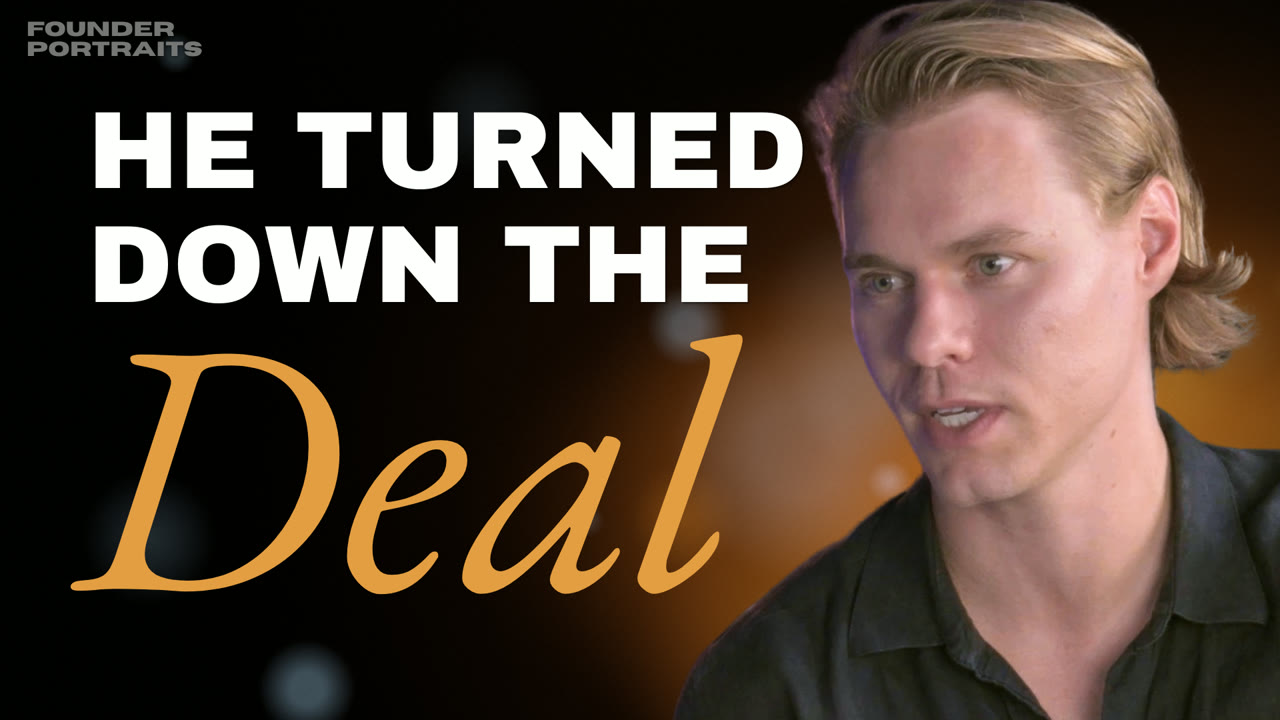
Cam Stajer started Kala, a red-light therapy company, from his parents' basement with $5,000 and a logo that cost him next to nothing. A few years later it's the official wellness-recovery partner of Team Canada through 2028, on shelves at Costco and Walmart, and still 100% his. In this episode he walks through how he actually got there: cold-outreach that opened doors he had no business getting into, the Dragon's Den deal he turned down, a product recall that could have ended the company, the grind of medical-device approvals, and going three years without paying himself.
Transcript: Cam Stajer on Founder Portraits
0:53Meet Cam: CEO of Kala Therapy
ChristianneCam Stajer, thank you so much for coming on. It's been so long since we saw each other last. Nothing's happened in your world, right? I don't know anyone else who has excelled in so many different domains. Semi-pro athlete, model, I'm pretty sure you DJ'd at one point. You launched a multi-million-dollar business from your house, and you've negotiated massive deals. Are you anywhere close to being done?
CamI think we're still in the first inning. It's been a crazy journey and a blessing so far. But we're just getting started.
1:3520 years of hockey and what it taught him
ChristianneLet's go back to the hockey days. Twenty years in hockey. What has hockey done for you as a person, and how does it still influence you today?
CamI grew up in Canada, where everyone loves hockey. The dream was always playing in the NHL. My dad was super intense when I was a kid: getting to the rink, practicing, doing the dryland outside. It was a big part of my life, with teammates, trying to make it to the big leagues. That gave me my drive and motivation, being on a team and trying to win. And every day as a founder there are competitors trying to beat you. You have to stay sharp and keep that competitive spirit.
2:40Discovering red light therapy
ChristianneWhy wellness, of every industry?
CamI played hockey for about twenty years, then stopped and went to school. I did business at Western, and I kind of lost myself. Sports had been my identity, and after that I didn't know where I fit. Everyone around me was super smart, doing the Ivy road, getting A's. I was never a books guy. After graduating I did about two months in banking, which wasn't my fit either, then went into commercial real estate for about a year.
During that time I came across red light therapy through a podcast. I was driving to a friend's house listening to Ben Greenfield, a legend in the health space, and he talked about red light therapy and the benefits for skin health, muscle and joint pain, hair growth. I wanted to buy one for myself, and it was a fortune. A thousand bucks for a small light panel. I had no money at the time, so I couldn't afford it. But I always thought it was an amazing idea, before it was cool. This was over ten years ago. Then one day my buddy, who became my co-founder, and I were talking about starting an e-commerce company, and red light therapy came up. My love for health and wellness from hockey was a big part of it.
3:56Starting Kala: a $20 logo, Alibaba and the name
ChristianneSo you saw a gap between what these devices cost and what they could cost.
CamWe went to Alibaba, which is the source for anyone in e-commerce looking for a supplier, and it was a fraction of the price. For the name, I always thought K's were huge in America, with the Kardashians and Kanye. I was young. So I went on a name generator and looked up four-letter words starting with K, kept pressing reset, and Kala came up. It was almost intuition. I saw it and thought, this is it. I looked it up and it means sun in Hawaiian, which fit perfectly for light.
Then I went on Fiverr and paid a guy twenty bucks to make the logo. We ordered samples from Alibaba, found one that was good enough, and screen printed our logo on the back of the device. That was about six and a half years ago. Now everything is proprietary. We started with five thousand dollars between my partner and me. We were fresh out of college with full-time jobs, and we made a site. That's how we started.
6:02Going on Dragons' Den
ChristianneFor a lot of businesses, going on Dragons' Den isn't the right choice. A lot of founders want to keep a hundred percent of their equity, and I know that's part of your story. Why go on?
CamWe were about a year in. It's great for social proof and eyeballs, and eyeballs lead to conversions. We wanted that Canadian trust. And money was tight, so we wanted to look at trading equity for cash. We had three interviews, and you need a lot of entertainment value, because it's a show.
We were so nervous. You arrive and there's a big black drape you can peek through, and you can see the judges on the panel. It ended up going really well. We got a deal on the show, but we didn't take it after the show. The episode airs months after you film, and we had a lot of momentum by then. We felt it was a little early to take capital.
ChristianneWhat's something about the experience people don't see?
CamHow much of it is entertainment. A lot of these shows are more about entertainment than about the people pitching. So creating a fun, interesting pitch is something founders don't think about. And a lot of deals don't actually go through after the show. That's another misconception.
You walk on, and it's silent. There are cameras following you. You stand on the line and the dragons stare you down with their books, cross-legged. Then you go into your pitch, and you have no idea what questions are coming. We got asked about CAC relative to our average order value. I was twenty-three or twenty-four. I didn't know what CAC was. But I think everyone should do it if they have the chance. Even if you don't have a good answer, it's worth the experience.
9:19Early disaster: the Suez Canal shipment
ChristianneNo great business is built without bad days. A lot of the people who tune in are early-stage founders who wonder if their problems are unique to them. Take me into one of your early days when things weren't going to plan.
CamThere are so many. In e-commerce, empty shelves don't sell. If you make a great, high-quality product, it will sell. The problem is shipping. Air shipping is like the cost of a Porsche. So we'd finally gotten past that. We had all our goods ready before a huge sales period, and we'd spent all of our money on a container on the sea.
Remember when the Suez Canal got blocked? Our container got stuck. We were sitting on our hands, thinking, what are we going to do? We have no money. We were already two weeks delayed into our Canadian warehouse. We'd take out debt to air product in, it was Q4, customers were asking for refunds, and you've already paid to acquire those customers.
10:49Betting the whole farm
ChristianneYou literally had no money.
CamZero money. I've bet the whole farm probably twelve times. You put all your savings into the company and take out debt through the bank or other platforms. And when you have no inventory, your customers are refunding, and you've paid maybe a hundred bucks to acquire each customer on a seven-hundred-dollar order. It was really challenging.
ChristianneWhat was it like to take that leap?
CamI think you have no choice. If you want to grow and be a real brand, you have to take risks. It was always non-negotiable for me. Your podcast is called GUT, and that's fitting. You have to go with your gut, and if you believe in it, you bet the farm on it.
12:12Paying himself $0 for three years
ChristianneWhat's the least you've ever paid yourself?
CamCan I say negative? I didn't pay myself a cent until about a year and a half ago. Zero dollars for at least three years. The first year I had another job, and I'd work from five until midnight with my co-founder on laptops: building the store, making email campaigns, designing in Canva before AI existed. Every founder who's scrappy has done every task in the business.
I put more of my own money in, too, because every dollar in the company could be worth three or four dollars if you're buying inventory at a good margin and selling it. I was living at my parents' place, just getting by. They were supportive. They knew I had drive, and I'd always been entrepreneurial. My dad owns a cell phone store, so in high school I'd bring phone cases to class and sell them to buy a speaker. I did pool cleaning, everything. But red light therapy wasn't a thing back then, so the product was probably concerning at first. What's this light going to do for your health? Thankfully, they believed in me.
14:33The $1.5 million Costco recall
ChristianneWere there days after Dragons' Den where you thought, I don't know if Kala is going to keep existing?
CamThere were a million. We've been in Costco for the last few years, and Costco has a lifetime return policy. People can return a dishwasher from ten years ago.
A customer had one of our devices overheat. I think it was sitting next to a very hot heater. And we ended up with a recall because of a manual issue: the manual didn't include a temperature warning. It wasn't a product defect. But we had to refund about a million and a half dollars to consumers, and all the product came back. At the same time, I was going through the process of buying out my co-founder, and other things were happening too.
We took the returned products and created a refurbished program. If you want a device for less, you can buy it in the outlet section on our site. That helped keep us afloat. But it was a really hard point.
ChristianneDo you remember staring at the wall, thinking, what am I going to do?
CamOf course. There were times I was staring at the ceiling thinking, how in the world is this going to work? But my motto has always been that action gives you results. You keep chipping away, go back to the drawing board, and figure out how to make it work.
17:52The dumbest mistake: wiring $50k to the wrong supplier
ChristianneFinish this sentence: the dumbest thing I did early on was...
CamWire fifty grand to the wrong supplier. It was in the first few months of business. Back then wiring money was hard. You had to go to the bank and manually enter the numbers. And I sent it to the wrong supplier. We had to ask them to trust us and please send the money back. My partner was like, dude, how did you send the wrong supplier money? It was fully my fault.
They sent most of it back. We'd only had a few video calls with them, and they're overseas in China, so you're calling at night and in the morning. I lost about six grand on the exchange from Canadian to US dollars, but we got most of it back. I got lucky.
21:00The Q4 inventory Hail Mary
ChristianneWas there ever a Hail Mary in Kala's lifetime?
CamWe take a Hail Mary every Q4. Q4 is Black Friday, Thanksgiving, Christmas, the holidays. It's massive. To have a big Q4, you have to order inventory and ship it by sea, because air is a fortune. So you raise a ton of money in the summer to pay suppliers. It takes about sixty days to make the goods and another two months to ship them. We've raised millions of dollars for Hail Marys, emptying all our accounts and raising equity-free debt.
ChristianneAnd at that point you have no idea what sales will look like.
CamNo idea. As you grow, you can forecast from previous years and your customer data. But inventory over Q4 is the Hail Mary most e-commerce founders take.
ChristianneDo you still feel the fear?
CamNot anymore. Even if it doesn't sell out, we'll have Q1 to sell through. And I'm so confident in the category. Everyone is investing in their health now. Obviously it's scary, but I see it as no other option.
22:54Hype, misinformation and medical-device approvals
ChristianneWhat's it like to be in a category where there have been so many products that are hype and fluff, not science backed?
CamEducation is really important. Red light therapy was very woo-woo at first. It looks like a flashlight. How is this going to help my cells heal? But there have been over seven thousand clinical trials on light therapy, for acne, fine lines and wrinkles, chronic pain. Red and near-infrared wavelengths help the mitochondria in your cells produce ATP, the energy your cells run on.
And it's actually a Class II medical device. The FDA, Health Canada, the TGA in Australia and the regulators in Europe all treat it very seriously. It's about thirty thousand US dollars to get one device approved by the FDA, and then again with Health Canada. When we started, the category was so new that the rules weren't clear, and then we had to pay to get all our units approved. But now I see it as a moat. Not everyone can order red lights from China and sell them if they need medical-device approvals.
26:40Loneliness, mentors and building solo
ChristiannePeople see the Olympic deal and think you've made it. What don't they see?
CamThe times you're alone at your laptop. It's dark out, your friends are out on a Friday or Saturday night, and you're sitting there with this vision of a company. It's very lonely being an entrepreneur. People with jobs have relationships with their coworkers, a bit of a clique. As a founder, you're often alone. It's like Ronaldo training by himself as a kid. No one saw him then. They see him in the stadium with a massive crowd cheering. The cheering is great when you're doing well, but the times of silence are what make those moments.
ChristianneDo you have mentors you seek guidance from?
CamI heard a quote that being a founder is like jumping off a cliff and building the plane on the way down. It's very unglamorous. I still put out about three fires a day. I have some great mentors. One is John Firstbrook. We met at our university graduation, of all places, and he has great experience in the insurance world. I think having a mentor around your dad's age is great, because they've seen the road ahead. My dad is an amazing mentor too.
If there's someone great in your industry, reach out. I love helping people out, and I think most people do. If they don't, you can skip them anyway. But honestly, a lot of it was solo. A lot of YouTube videos and figuring it out myself. Now I lean on founders who are older than me, and it's great to have that light down the road.
28:42Who shouldn't be a founder, and ADHD as a superpower
ChristianneWhat's one trait that means someone should definitely not become an entrepreneur?
CamBeing risk averse. Some people are too smart to be entrepreneurs. They think through everything that could go wrong. The balance sheet, the competitors who've raised a hundred million dollars, the celebrity founders. If you love it and you're passionate about it, that's when you should do it. But risk is the biggest thing.
ChristianneDo you think ADHD is essential for a founder's success?
CamI don't think it's essential, but it's definitely a superpower if you can hone it. I have ADHD. Growing up, I was in special classrooms, in smaller groups, because I was so distracted and not very good at school. I was kind of written off. People thought I wouldn't be able to hold a job. But as you get older, it can be a superpower. You have unlimited energy and you can focus on a million things at once. If you can't control it, it's very challenging to put systems in place. So it's really about learning how to be the best person with that trait.
ChristianneAt least eighty percent of the founders I've interviewed have mentioned they have ADHD. Clinically diagnosed.
CamThat's so interesting. I was prescribed as a kid, but it didn't last long. My dad thought it was going to stunt my growth for hockey, so he said, we're taking him off it. Let him be crazy.
30:20Growing up "different"
ChristianneWhat did you believe about yourself growing up, when you weren't the best student?
CamIn grades five and six I went to a school downtown called Dunblane. We were a middle-class family, and my parents invested in it. The classrooms were really small, and it was focused on helping kids be confident, kids on the spectrum or with ADHD. I always thought I was different. Why can't I fit into the classroom structure? I had too much energy, I guess. I thought I'd been written off, and that sports were the only way it would go. But it all turned around. Everyone is different, and leaning into what makes you unique is so important. That's kind of the story of how Kala started.
ChristianneDo you still feel different?
CamThe way we run Kala is very abnormal. There's something new every day. We have an office in Toronto, but everyone is all over the world. On Fridays we do Rose and Thorn: your best thing of the week and your worst.
ChristianneA rose and a thorn but no bud? The bud is something you're looking forward to.
CamWe have to include that. That's smart.
32:00Envy, Forbes 30 Under 30 and what nobody sees
ChristianneThere's a lot of envy around founder life. People see the splashy numbers, a big campaign, a partnership with a world-renowned brand. If someone knew everything about your situation, would they be jealous of you?
CamThey'd be envious of the frosted glass, the Instagram and LinkedIn version. But they probably wouldn't trade. There's a quote: people would trade for your life, but not for what it took to get it. I had a really tough three or four years starting the company. It was super stressful. I got Forbes 30 Under 30 about a year and a half ago, which is a founder's dream in your twenties. It was really cool. But behind the scenes there was so much going on that was unenviable. I was buying out my co-founder, we had the recall. So don't believe everything you see online. Nobody shows the bad moments. And honestly, I think people should show more of the bad stuff, because people want to buy the story.
ChristianneWhat do you think when someone puts Forbes 30 Under 30 on their vision board?
CamI think it's a great tool. I've had vision boards since I was a kid. My mom gave me The Secret when I was young. She was an almond mom. I was gluten-free before gluten-free was a thing, and my friends called her snacks bird food. Forbes was on my vision board since I was about seventeen. I had it on my dorm wall in college. I've looked back at my old boards in a storage locker, and I've gotten pretty much everything on them.
You have to have a target to know what to hit. You come back to your dorm or your house after a hard day and you see the vision. This is what I want. Subconsciously, it helps you figure out your next move. So if you don't have a vision board, definitely get one.
34:47The Olympic deal
ChristianneIf you could go back to the kid lacing up his skates at six in the morning, what would you tell him?
CamPlaying hockey was my dream, especially growing up in Canada, with the ponds in the winter. I'd probably tell him it may not work out here, but it's going to work out in a bigger way, in a different category. Now I have friends who play in the NHL, we've done a full partnership with the San Jose Sharks, and we're at the Olympics. Things work out for you, not against you. Sometimes the universe has plans for you that are bigger than you think.
ChristianneLet's talk about the Olympic deal.
CamMy best friend Spencer and I were in Greece, walking through Athens, and we heard about the first Olympic stadium. It's all white marble and looks a bit like the Colosseum. We went there and ran laps, and we had this euphoria, seeing the torches from past Olympic Games on the wall. Spencer knew we were working with a lot of athletes, and he said, you should try to get the Olympics. So we cold emailed the Canadian Olympic Committee.
ChristianneYou cold emailed the Olympics?
CamWe cold emailed them. "Hey guys, we're Kala, we have red light therapy devices, we'd love to do a partnership." We followed up a couple of times before we heard back. They're very strict, because protecting Olympians and their health is so important. We got approved within about a month, and the whole deal was done within three months. They told us it was the quickest deal ever in Canadian Olympic history.
We had licensed productsthe Kala Mini 2 and the mask, with the Olympic rings and the Canada logo next to ours. But it was so close to the Games that we had to manufacture devices right away, and they had to be the exact Team Canada red. We sent a sample, they said change the color, and we produced the products trusting it was right. We made ten thousand units. Thankfully, it was the right color.
Then we signed athletes within a monthSarah Nurse, the amazing hockey player, a speed skater, a figure skater. Calling agents, figuring out shoots, getting contracts done. All in about three months. It was a huge investment. I can't disclose it, but it's a four-year deal: Milan 2026, and then LA 2028.
ChristianneSo it's exclusive?
CamWe're the exclusive official wellness recovery partner. No one else in our category can work with Team Canada or use the logos for four years. Everyone buys a category. It was our biggest and most expensive deal, but it's been great, and we want to support our athletes.
ChristianneWhat would your younger self think of the Team Canada deal?
CamGrowing up in Canada, the Olympics is huge. I think it's bigger than in the States. Classrooms would roll a TV in on a stand and play the games, and everyone wore red with face paint. I remember the red Hudson's Bay mittens and Sidney Crosby's golden goal in 2010. So it was a full-circle moment, especially as a former athlete. We had devices in the room with Team Canada hockey for them to use after games. It doesn't feel real sometimes. When you're building, you don't always appreciate the moments. That was the top moment in the business so far.
42:52The Richard Branson cola story
ChristianneWho's an entrepreneur who changed the way you think?
CamRichard Branson. I love how different everything is at Virgin: a phone company, hotels, airlines. And he takes risks on new categories and has fun.
ChristianneWhat's the story about his cola brand?
CamApparently Richard Branson drove a tank through Times Square. He had a drink company in the UK that was crushing it, and he came to the US with this tank rolling over Coca-Cola cans, to show them, we're in New York now, we're taking ground here. And then Coke went behind his back to retailers across the UK and took over his shelf space. It backfired on him, no pun intended. But I love the mindset of trying to dominate a whole new category.
44:47The Shopify screenshot on his vision board
ChristianneDo you recognize this?
CamOh my gosh. Where did you get this? Did you print it off? This is a screenshot of one of my first Shopify sales. I printed it and put it on my vision board. When you get your first sales on Shopify, you hear that cha-ching, and it's addicting. It's the best feeling in the world. I had that on my vision board for six years, as a reminder of getting more sales and seeing it come to life. And yes, it was a real sale. I can't believe you printed this.
45:31Manifestation and training the mind
ChristianneWhat's the most unhinged thing you've done to train your mind?
CamI've put manifestation episodes on a laptop to play while I slept. You wake up with crazy dreams. I've done the 3-6-9 method: you write your affirmations three times in the morning, six times midday, and nine times at night. I've had crystals. Pyrite is supposed to be good for abundance, so I'd carry a piece of pyrite in my pocket to big meetings, including Dragons' Den.
A lot of it is spiritual. You really have to believe in what you're doing.
ChristianneI've heard that writing something down isn't only willing it into existence. It also makes you believe it's true and rewrites the narrative in your head. Your mind starts connecting the dots forward to how it will become true.
CamThat makes sense. I bought a journal in Amsterdam that looks like The Odyssey on the outside and is blank inside. Every other day I write in it. It's my manifestation book. I think about my life like a movie. What would the main character do in my position right now? That's how you have to live and take your chances. And when you write things down, you can look back and see how much you've grown.
48:42Being the main character
ChristianneDo you feel like you're the main character in your own life?
CamI do. My phone screen says "pressure is a privilege," with an F1 driver and everyone around him getting the car ready to go back on the track. When you have kids, they become the main characters, and there are many main characters when you have a family. But you have to live like you're the main character in your own movie. Take the big swings now, and push the envelope.
49:19What's next for Kala
ChristianneWhat's next for Kala?
CamI think we're in one of the first couple of innings. We want to take the company global. About ninety percent of our sales are in Canada right now, and the US is our second-biggest market. We have new products launching very soon, including new panels that have taken three years to make. They're the Ferraris. I truly think they're the best devices in the world.
We're also building an app that connects to your health data through wearables, so if you use the panel at night you can see how you slept before and after red light therapy. Actual data, so you can see whether it's doing something or it's placebo. I think we could be a real contender with the big health-device brands. There's a lot to look forward to.


